






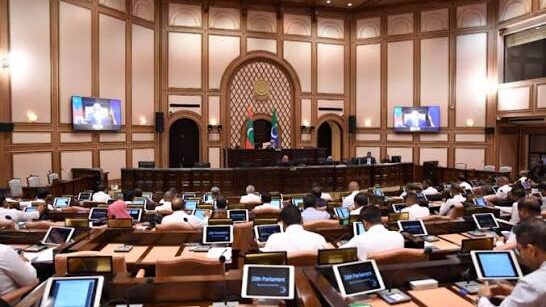
Work on a bill to amend the Penal Code to criminalise acts against a particular religious group and acts that harm the economy has been removed from the agenda of today's People's Majlis sitting, after it had been included.
The bill, submitted on behalf of the government by Maafannu South MP Abdulla Rifau (Boche), seeks to make genocide a criminal offence in line with the Genocide Convention, to which the Maldives is a party. The Majlis media official said the reason for the change, made after the bill was placed on today's agenda, was still being confirmed.

The bill would criminalise acts of genocide, such as causing serious bodily or mental harm to members of a group belonging to a particular nation, race, descent or religion. It would also make it an offence to knowingly damage key infrastructure or computer systems in a way that could cause serious harm to the state's economy.
Under the bill, committing genocide against such a group, or publicly calling for it, would be classed as a first-degree felony, with a base sentence of 10 years in prison and a maximum sentence of 25 years.
Following the bill's submission, allegations surfaced on social media that the amendment was intended to stop people from voicing opposition to the Rasmalé project. However, Attorney General Ahmed Usham has denied the allegations, saying the bill was submitted because an international treaty requires it of the Maldives.
In a social media post today, Attorney General Usham said that although Article 5 of the Genocide Convention, which the Maldives joined in 1984, requires genocide-related offences to be included in law with penalties set for them, the obligation had still not been fulfilled after 42 years.
He also noted that the Maldives has intervened in the cases against Myanmar and Israel at the International Court of Justice (ICJ), and said that failing to meet this obligation while calling on other countries to respect the convention affects the Maldives' legal arguments.
Leave a reaction