






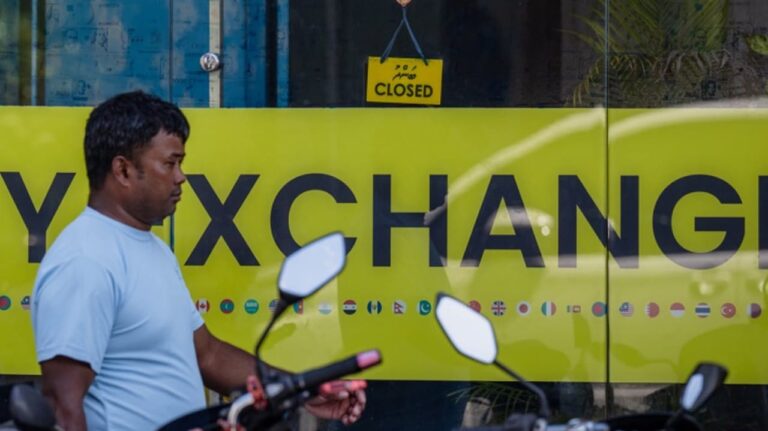
The central bank, the Maldives Monetary Authority (MMA), has brought into force a new regulation that sets MVR 50,000 as the maximum amount money changers can transact in cash, either in a single transaction or with a single customer within one day.
Under the regulation, drawn up under the Foreign Exchange Act, any transaction exceeding MVR 50,000 or its equivalent in foreign currency must be conducted through the registered business’s primary bank account. Money changers are also required to deposit any excess foreign currency held at the close of business into their bank account on the next official working day.

Commercial banks registered in the Maldives are exempt from the regulation, which applies only to businesses providing foreign currency exchange services commercially.
Under the new regulation, licences to provide foreign currency exchange services to the public (Category A) will only be issued to companies dedicated to the business and whose ultimate beneficial owners are Maldivian citizens. Only one licence will be issued to each corporate group. Resorts have also been given special permission to sell foreign currency to tourists staying at their properties.
Each holder of a licence, which will be issued for a period of five years, must place a security deposit of USD 200,000 with the MMA, along with a deposit of USD 100,000 for each service outlet in addition to the main place of business. The licence application fee has been set at MVR 40,000, while the renewal fee is MVR 20,000 and the annual fee is MVR 48,000.
Service outlets must be set up in an office environment that ensures the safety and confidentiality of customers. Money changers are also required to display exchange rates on a digital board and issue an official receipt for every transaction. In addition, they must keep transaction records for at least five years, establish an electronic system to monitor transactions in real time, and submit audited annual financial statements to the MMA.
The regulation also states that strict action will be taken against those who violate it and those who operate the business without a licence.
Leave a reaction